
The travel industry is facing familiar, frustrating headwinds. A recent New York Times op-ed laid bare the harsh realities facing transatlantic travel this summer: soaring jet fuel prices and complex geopolitical situations have combined to make trips to Europe, the Caribbean, Asia, or anywhere more than 200 miles from home prohibitively expensive, operationally difficult, and significantly reduced.
For the average consumer, it’s a reason to stay home. But for destinations, hotels, cruise lines, and airlines, this downturn shouldn't be a signal to retreat—it’s a massive marketing opportunity.
When times get lean, conventional corporate wisdom often dictates cutting the marketing budget to protect short-term margins. History shows us that it is a mistake. The brands that win the long game are the ones that double down on their Share of Voice (SOV) when everyone else goes quiet.
The SOV Advantage: Winning Market Share in Lean Times
In marketing, it’s a well-documented law of physics: Share of Voice drives Share of Market.
When an industry faces a downturn and competitors pull back on ad spend, it creates an artificial silence in the marketplace. If your brand maintains or increases its marketing presence during these periods, you gain what is known as Excess Share of Voice (ESOV).
- Less Noise, More Impact: Your message doesn't have to fight through a crowded field. It cuts straight through.
- The Trust Factor: Active marketing signals stability, longevity, and confidence to consumers.
- The Post-Downturn Payoff: When the market inevitably recovers—and it always does—the brands that stayed top-of-mind don’t just recover; they capture the market share surrendered by their quiet competitors.
But how do you market a destination, a luxury cabin, or a transatlantic flight when consumers are feeling priced out of the actual journey?
You change the geography of the experience. If travelers can’t come to you, you must go to them.
Bringing the Destination to the Doorstep
Modern travel marketing needs to move beyond static digital ads and aspirational Instagram grids. If consumers are grounded by economic friction, smart brands will bring the essence of their experience directly to where those travelers live—in real life, in real time, and through fully immersive environments.
Our agency recently proposed this exact philosophy as a proof of concept for Switzerland Tourism.
Case Study: Switzerland 3600 – An Immersive Experience
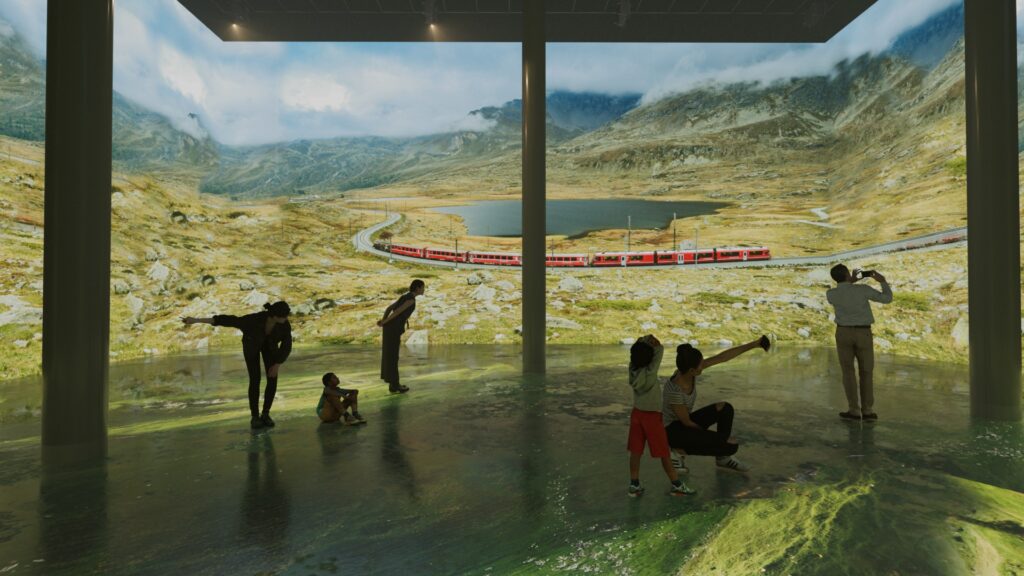
Rather than fighting the uphill battle of high transatlantic flight costs, the strategy was to bring the Swiss experience directly to the U.S. consumer. We designed a fully immersive activation to be deployed across three major U.S. cities.
It wasn’t just a video screen; it was a 360-degree sensory journey:
- Sight & Sound: High-fidelity 360 projection mapping coupled with spatial audio of alpine winds, cowbells, and rushing rivers.
- Scent: Ambient diffusion of crisp mountain air, pine needles, and fresh alpine flora.
- Taste: Curated, real-time tastings of authentic Swiss chocolate and cheeses.
While it remained a proof of concept, the underlying thesis is more relevant today than ever. By allowing travelers to experience the essence of Switzerland in a hybrid physical-virtual world right in their own backyards, the brand builds a deep neurological connection that lives rent-free in consumers' minds until they are ready to book. See the case study here.
The Imperative for Airlines, Hotels, and Cruise Lines
This experiential pivot isn't just a playground for tourism boards. Every sector of the hospitality ecosystem can leverage this "go-to-them" approach:
- Airlines can bring their premium cabin experiences to ground-level pop-ups in major metropolitan hubs, letting consumers sample the luxury of a first-class seat or a signature in-flight menu without a boarding pass.
- Cruise Lines can deploy interactive, virtual-reality decks at high-foot-traffic outdoor markets, giving potential passengers a literal taste of the ocean breeze, onboard entertainment, and the spatial scale of their newest vessels.
- Hotels & Resorts can recreate the sensory environment of their flagship lobbies or luxury spas in key feeder cities, offering an oasis of hospitality and brand recognition amidst a busy concrete jungle.
Future-Proofing Your Brand
The current travel landscape of 2026 is challenging, but it is not permanent. Fuel prices will eventually stabilize, and geopolitical tensions will shift. Europe, the Caribbean, Asia and the high seas will always be there waiting.
The question for travel executives isn't if the market will bounce back, but who will own it when it does.
Don't let your brand go dark just because the skies are crowded with challenges. Go to your audience, meet them exactly where they are, and give them a tangible, unforgettable taste of your brand today. They will reward you by booking with you tomorrow.